Dosharen
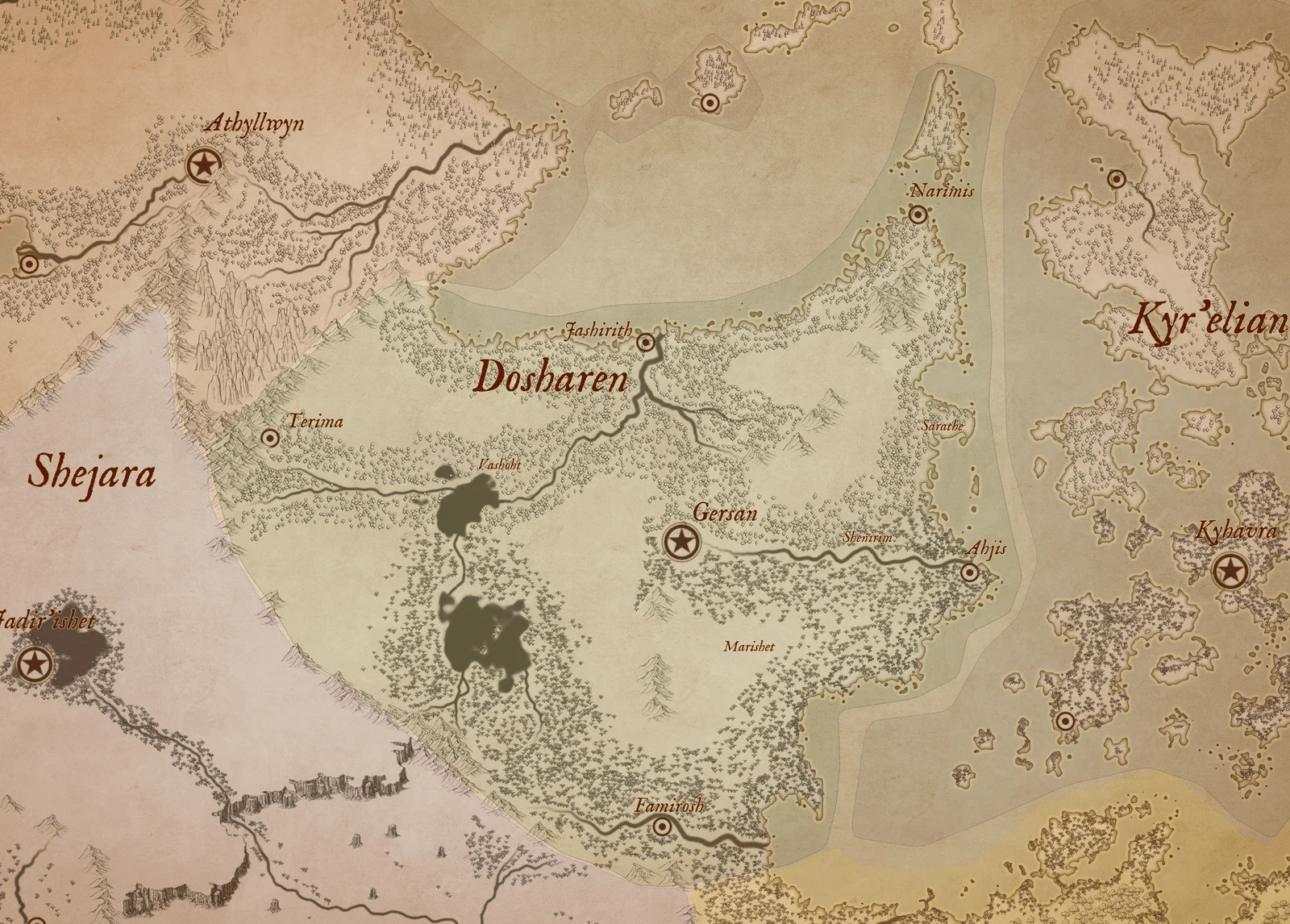
Dosharen is an inland republic governed by competing Highborn houses rather than a single ruler. No house has ever consolidated enough power to seize sole control, and the system has been in this state of productive gridlock for centuries. The capital is Gersan, a mountain-spring city that serves as the republic’s political and spiritual center.
The Janim are Dosharen’s dominant lineage. Their culture prizes argument, intellectual life, and civic participation. The Yrialin faith runs deep here, particularly in Gersan, which holds the only Yrialin cathedral on the Remnant Continent.
Government
Section titled “Government”Dosharen is a fractured republic. Power is distributed across the Highborn houses through a council system in Gersan, where no single house controls the vote. The republic functions because every major house controls something the others cannot do without, and destroying a rival means destroying a piece of the system you depend on.
Currency is the mechanism that keeps the peace. Dosharen coinage requires Daruner blood to infuse Ren into the metal. Every major house has Daruner blood, which means any house could theoretically mint. The Gersan Mint is run jointly, with multiple houses providing oversight, because none can afford to let another control the money supply alone.
GM: The Gridlock
Each house controls something the republic cannot function without: Ristila’s moral authority legitimizes the council, Oshim’s trade network connects Dosharen to the coast, Dash’rii’s Gate relationship provides Ren expertise and military-relevant research, Adimor’s land feeds the city. Remove any one and something essential breaks. This mutual dependency prevents open warfare but also prevents consolidation, reform, or decisive action on anything.
House Sejathin’s recent rise is threatening precisely because they bring something new, Marathat ruin discoveries near the Shejaran border, that does not fit the existing dependency structure. They have leverage without a traditional niche, and nobody knows what to do with that yet.
House competition turns personal when concessions change hands. The houses do not fight with swords in the streets. They fight with economic pressure: reallocated river concessions, lost patronage networks, livelihoods ended without a threat ever being made explicitly.
The Houses
Section titled “The Houses”| House | Seat | Sphere |
|---|---|---|
| Ristila | Gersan | Religion and moral authority. The most prominent council house. Draws legitimacy from deep Yrialin alignment. When Ristila speaks in the council hall, it carries moral weight, not just political. |
| Oshim | Shenirim | River trade and docks. Controls barge concessions and dock district operations across the eastern river system. Nouveau riche by old-house standards; the most connected to Kyr’elian and Gankoran merchants. |
| Dash’rii | Gersan | Ren research and the Gate. Oldest ties to the Gate of Zerathrain, going back to the Erbaune Empire. Funded Gresin Orin’s early research. Other houses are nervous about this. |
| Adimor | Marishet | Agriculture and forestry. Controls the largest share of Dosharen’s farmland and forest holdings. Conservative, resistant to change. When Adimor is unhappy, food prices move. |
| Reshani | Ahjis | Harbor tariffs and foreign trade. The oldest Ahjis house, and the most internationally connected in Dosharen. Controls who docks at Ahjis and what it costs. |
| Diramesh | Terima | Kerim mining. Controls the largest kerim deposits in the northern range. Their Daruner blood has been used for generations to infuse kerim into construction materials. |
| Tareshin | Vashoht | Turim refinement and distribution. Primary refiner of Ren-infused metals. Supplies the Gate of Zerathrain and military contracts across Dosharen. |
| Ejarif | Jashirith | Mountain passes and overland trade. Controls the routes toward Lithywae. Politically exposed; other houses accuse them of too-close dealings with Nylvish merchants. |
| Majithem | Narimis | Fishing fleets and coastal supply. Less prestigious than Reshani but economically essential: feeds the city and keeps the coastal supply chain running. |
| Shirajen | Sarathe | Shipbuilding and naval contracts. Rose to prominence through joint merchant vessel contracts with the Kyr’elian Assembly. Builds ships for half the eastern coast. |
| Sejathin | Famirosh | Marathat antiquities (minor, rising). Recently gained leverage through ruin discoveries near the Shejaran border. Hungry in a way established houses are not. |
How House Politics Reaches Ordinary Life
Section titled “How House Politics Reaches Ordinary Life”Employment: The houses own things: warehouses, river concessions, agricultural land, processing workshops. Your employer’s house affiliation shapes your life in ways you may not have chosen.
District identity: Neighborhoods lean toward different houses through generations of patronage and employment. People know which districts belong to which house the same way people in any city know how neighborhoods align politically.
Marks and symbols: Houses have identifying marks, colors, and architectural signatures visible on warehouse doors, barge flags, shop signs, and servants’ clothing. The political geography of any Dosharen city can be read by paying attention to which marks appear where and in what concentration.
Favors and patronage: House patronage expedites permits, opens doors to education, and provides faster dispute resolution than the council courts. Every favor creates an obligation. Over a lifetime, an ordinary resident accumulates a web of small debts to one or more houses that shapes behavior without anyone making an explicit threat.
Notable Locations
Section titled “Notable Locations”Terima
Section titled “Terima”Terima is a mountain city in the northeastern range, seat of House Diramesh. The city is built across the upper slopes of a kerim-rich mountain system, and its skyline is dominated by quarry infrastructure and the smoke of Ren-infused stone processing. The Gate of Zerathrain maintains a satellite campus here dedicated to kerim research.
Terima has become the most-watched city in Dosharen in recent months. During a deep-shaft kerim excavation, Diramesh workers uncovered a structure unlike anything the miners had seen: a massive gate of Marathat construction, buried well below the mountain’s natural stone. Its scale and apparent age immediately drew the Gate of Zerathrain’s full attention.
No one has entered it. The gate does not open by conventional means, and the Ren signatures coming from within do not match anything in the Gate’s research records. The Famirosh campus scholars who study Marathat technology have been recalled to Terima. So has a contingent of Eventide Brigade officers, who arrived without explanation and have been quiet about why.
Both organizations are currently seeking Rennim with Shadow, Secrets, and Truth polarities for contracted work at the site. Terms are generous. They are not advertising what the contract involves beyond entry.