Kyr'elian
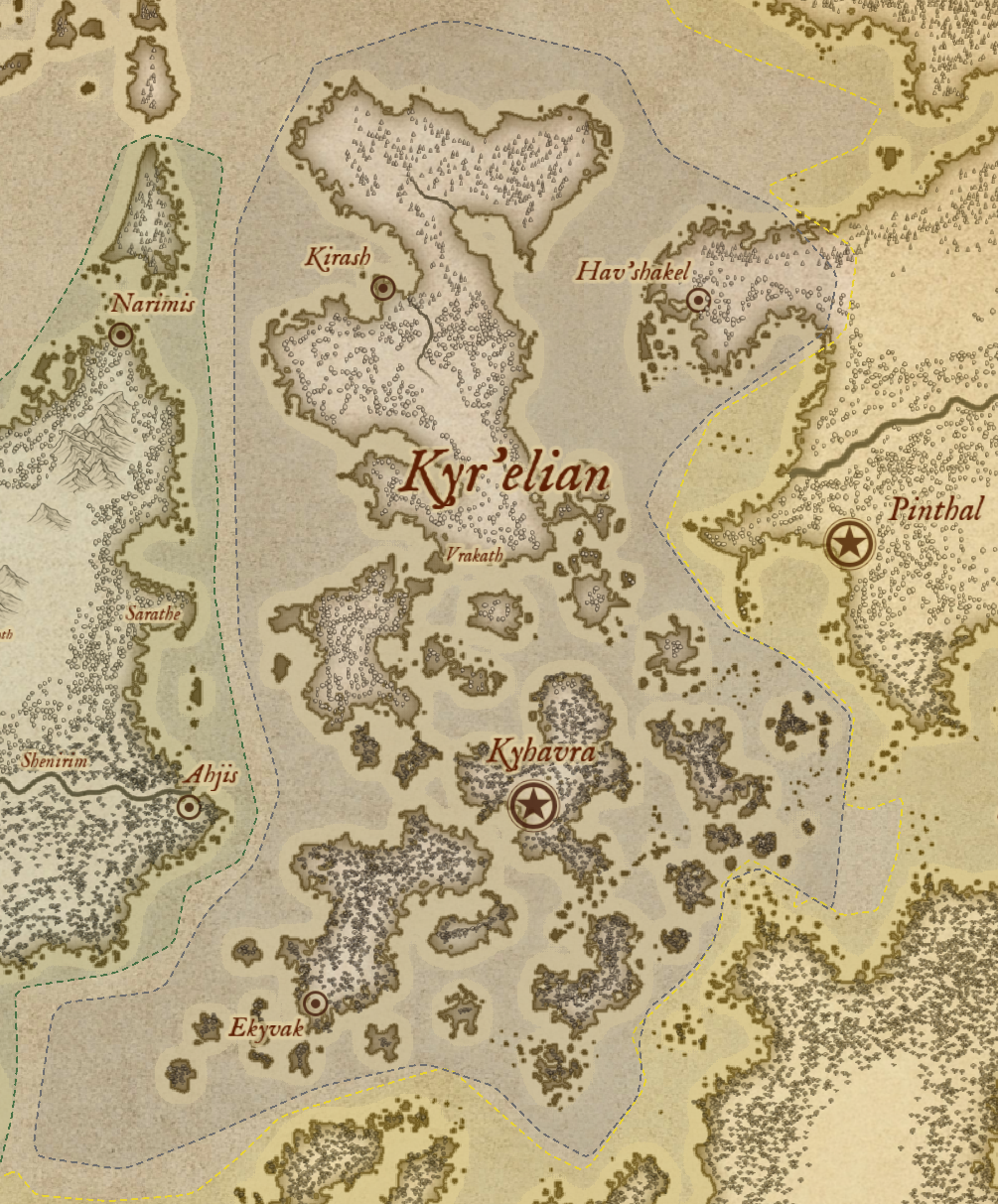
Kyr’elian is a maritime archipelago nation built on trade, transit, and the practical wisdom of people who have spent generations on open water. It was founded by the Elkyr, who arrived on the Remnant Continent with ships and the knowledge of how to sail them. What they built afterward reflects that origin: a nation that judges people by what they can do, maintains no hereditary ruling class, and treats every port as a potential opportunity.
The capital is Kyhavra, situated in the central archipelago. The nation is the most lineage-diverse on the Remnant Continent. Elkyr remain the founding and numerically dominant people, but Janim, Nyl, Anamor, and others have settled in large numbers across generations of open-door trade. Kyr’elian works because the people in it decided to make it work, not because any single group controls it.
Geography
Section titled “Geography”
Kyr’elian occupies a large archipelago positioned between Dosharen to the west and Gankora to the east, with open ocean to the north and south. The territory is not a single landmass but a collection of major islands and countless smaller ones, connected by sea lanes that the population navigates as readily as roads.
The terrain varies by island: the northern islands are densely forested and cooler, the central archipelago more temperate and heavily settled, the southern islands flatter and more exposed to coastal weather. The open channels between major islands are the highways of daily life.
Government
Section titled “Government”Kyr’elian is governed by the Assembly, a council of elected representatives drawn from the archipelago’s merchant, naval, and civic interests. Elections are open to all citizens and held on a regular cycle. The Assembly sets policy, controls the treasury, funds the Keldar, and manages foreign relations.
The three blocs that dominate the Assembly, merchant, naval, and civic, do not naturally agree. They are, in practical terms, business rivals who share a governing table. Merchant interests want favorable trade terms and minimal interference. Naval interests want funding, patrol rights, and the authority to act on threats before they become expensive. Civic interests represent the settled population of specific islands and cities, whose priorities often conflict with both. The result is a legislature that moves slowly on anything requiring consensus and quickly on anything where two of the three blocs can find common ground against the third.
This friction is not considered a dysfunction. It is considered evidence that no single interest has captured the government.
The Elathi
Section titled “The Elathi”The Elathi is a loose religious and philosophical tradition native to Kyr’elian, though its roots are older than the nation itself. It does not have a formal hierarchy, a unified scripture, or mandatory practice. What it has is a shared orientation: that time is the medium through which reality is most honestly read.
Elathi practitioners, called seers in common usage, develop an attunement to the Sea and Protection polarities that allows them to perceive threats in the water, the weather, and whatever moves beneath the surface before those threats become crises. A seer on a vessel is not reading omens. They are listening to the sea the way a physician listens to a body: for what is wrong before it becomes visible.
The Elathi shares an underlying impulse with the Amber Faith of the Shejaran-Dosharen borderlands. Both orient around perceiving what is hidden for the sake of those who cannot perceive it themselves. How that impulse took shape, fire and purity in the borderlands versus sea and protection on the water, reflects the environments each tradition grew in more than any formal theological split.
Elathi practice is embedded in Kyr’elian maritime culture in the way that weather-reading and navigation are embedded: not as religion exactly, but as a body of knowledge that serious sailors take seriously and everyone else treats with cautious respect. Seers are not priests. They hold no formal authority. They are simply people who have developed a particular attunement that the sea makes useful.
The Keldar
Section titled “The Keldar”The Keldar are a maritime combat force operating out of Vrakath, answering to the Assembly with considerable operational autonomy. Their mandate covers the threats the Assembly’s standard forces are not structured to handle: monster tides from open water, piracy between the islands, and any situation requiring immediate overwhelming response rather than measured deliberation.
The Assembly funds the Keldar through a standing levy. On top of that baseline, the Keldar accept contracts from individual cities, merchant interests, and occasionally foreign clients. These contracts are taken at the Keldar’s discretion and do not require Assembly approval as long as they do not conflict with the standing mandate. In practice, the Assembly has opinions about which contracts the Keldar should take and makes those opinions known. The Keldar listens, considers, and proceeds as it judges appropriate.
The relationship works because the Keldar has never moved against Kyr’elian interests and has never been anything other than effective. The Assembly’s discomfort with their autonomy is real and chronic. It has never produced a serious attempt to restrict them, because restricting the Keldar would require all three blocs to agree, and at least one bloc always finds the Keldar more useful than threatening.
Outside Kyr’elian, they are called the Mad Dog Crew. Inside Kyr’elian, that name gets you a look.
Relations
Section titled “Relations”Gankora: The most straightforwardly functional relationship Kyr’elian maintains. The Assembly has treated the United Anamor Nation as a peer since the earliest formal contact, and the UAN has reciprocated. Trade moves through Kyhavra, directly across the channel from Corvesh. The Leviathan clan operates extensively in the waters between Kyhavra and Pinthal, and their presence in and around Kyhavra has deepened the relationship beyond simple commerce: the two nations share maritime intelligence about open-water threats that neither would have alone.
Dosharen: Active and profitable trade, concentrated through Ekyvak in the southwest where the sea routes from Ahjis arrive. Houses Oshim, Reshani, and Shirajen all have established presences in Kyr’elian ports. The relationship is commercial rather than warm. Dosharen Highborn politics reach Kyr’elian regularly in the form of house rivalries playing out in port negotiations, and the Assembly finds it tiresome. Trade continues because it is too valuable to stop.
Lithywae: Functional and transactional. Goods from Lithywae’s interior move through Nolmyr and Tyllym and into Kyr’elian’s trade network. Neither nation has given the other cause for serious grievance. Neither has pushed for anything closer.
Shejara: Indirect. Kyr’elian goods appear in Shejaran markets through the licensed coastal trade Shejara permits. No direct diplomatic relationship of substance exists. Shejara’s courtesy is complete and uninformative, which is a position the Assembly has learned to accept.
Notable Locations
Section titled “Notable Locations”Kyhavra
Section titled “Kyhavra”Kyhavra is the capital and the largest city in the archipelago, situated on the central island where the major sea lanes converge. The city grew from a deep natural harbor into a layered coastal settlement that now extends up the surrounding hillsides, its older waterfront districts compressed by centuries of construction above them. The Assembly meets here. Foreign embassies are here. The most significant concentration of Elathi seers on the continent operates here, though you would not know it from how quietly they conduct themselves.
Kyhavra is where the formal relationship with Gankora is maintained, with UAN representatives present in the city on a semi-permanent basis. The Leviathan clan has a consistent presence in Kyhavra’s waterfront, operating in the channel between here and Corvesh and Pinthal as readily as in their home waters.
Kirash
Section titled “Kirash”Kirash sits on the northern archipelago, the most remote of the major cities in temperament if not strictly in distance. The northern islands are forested and cooler, and Kirash has the character of a city that developed its own habits before the rest of Kyr’elian arrived. It is a working maritime city with deep Elathi roots: the tradition is more practiced and less casual here than in the southern islands. Seers in Kirash are not an informal cultural presence but a recognized part of how the city operates.
Hav’shakel
Section titled “Hav’shakel”Hav’shakel is Kyr’elian’s northeastern city, facing open water toward the unexplored reaches beyond Gankora. It handles significant traffic with the northern sea routes and has developed a reputation for accepting unusual people and unusual cargo without asking more questions than necessary. What arrives from the open northeast is not always easy to categorize, and Hav’shakel has learned not to try too hard.
The “hav” in its name echoes Kyhavra. Both cities sit on deep, sheltered anchorages. Whether the shared root is coincidence or an older Elkyr word for something like deep harbor has not been formally settled.
Ekyvak
Section titled “Ekyvak”Ekyvak is the southwestern city, positioned where Kyr’elian trade with the Dosharen coast arrives. It is the most commercially driven of the major cities: the merchant bloc’s interests are strongly represented here, and the city runs on the rhythm of cargo arriving from Ahjis and departing into the broader archipelago network. Ekyvak is where Dosharen house politics most visibly enters Kyr’elian, and where the Assembly’s commerce staff spend most of their working hours managing it.
Vrakath
Section titled “Vrakath”Vrakath is the Keldar’s home port, positioned to provide rapid access to the open water lanes the Keldar patrol. The city exists in a functional symbiosis with the force based there: the population works in support, supply, and repair of Keldar operations, and the Keldar’s presence keeps the surrounding waters clear of the threats that would otherwise make Vrakath a difficult place to live. It is not a large city. It is a precise one.
Because the Keldar’s presence keeps the surrounding waters reliably clear, Vrakath has also become a modest secondary node for internal distribution: some of the trade routes feeding Kyhavra route their warehousing and customs through the city, taking advantage of the security the Keldar provide. This is a supporting function rather than the city’s reason for existing, but it gives Vrakath a small civic-bloc constituency with strong opinions about infrastructure and reliable supply chains and considerably less interest in the naval and merchant blocs’ priorities.