Shejara
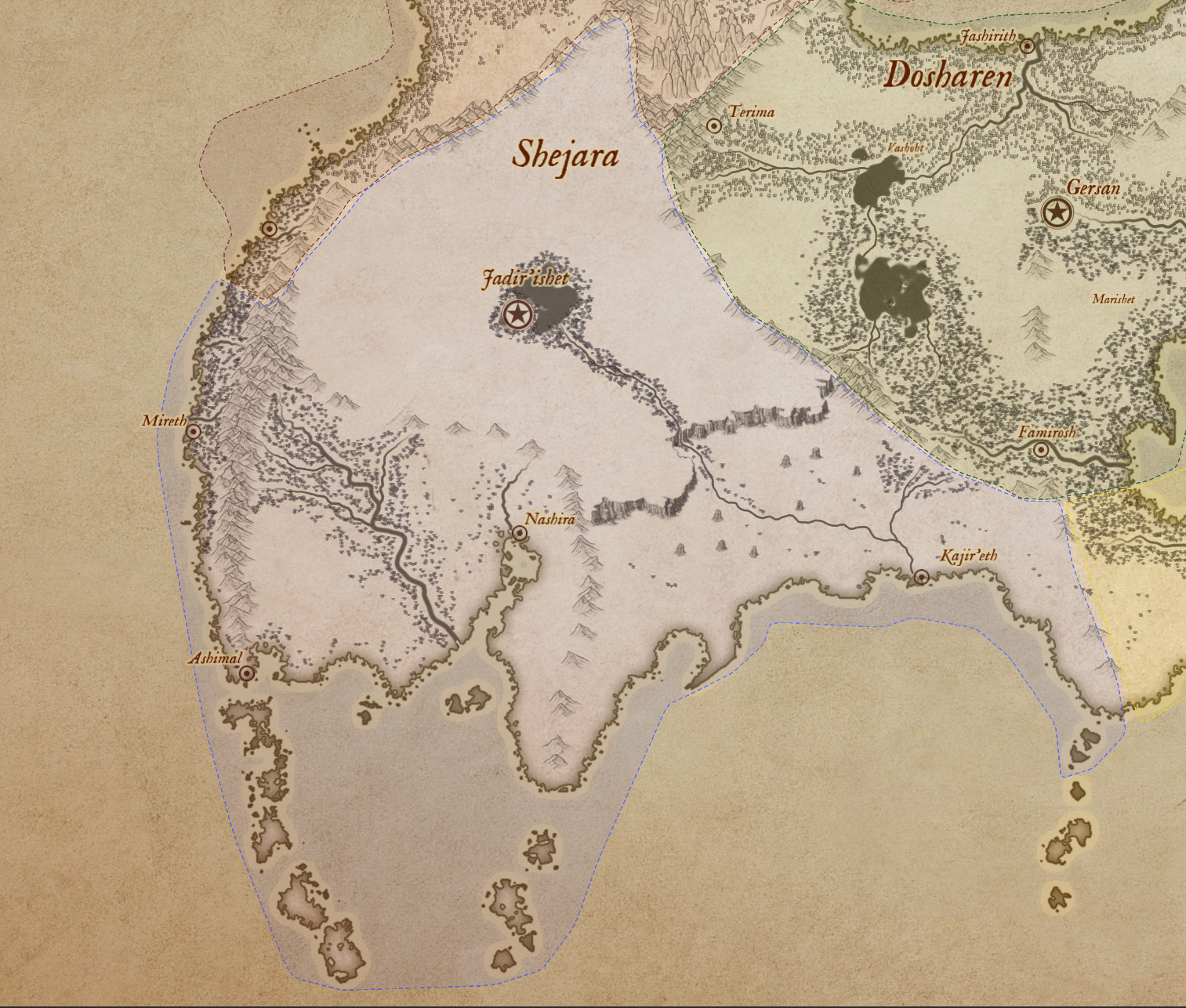
Shejara is a desert oligarchy governed entirely by House Dajimir, the only Highborn house on the continent that rules without a council, a parliament, or a competing noble body. The capital is Jadir’ishet, an inland city sustained by a water channel that predates any living record of how it came to be. The Order of the Divines, now widespread across the Remnant Continent, traces its organized institutional origins to Shejara: the faith was codified and propagated outward during the Erbaune era, and House Dajimir still considers itself its spiritual seat.
Shejara presents to the outside world as simply remote. The desert is harsh, the routes in are difficult, and the Princes receive envoys with perfect courtesy and say very little of substance. Most nations have concluded Shejara is poor, proud, and not worth the cost of forcing open. That conclusion suits House Dajimir exactly.
Geography
Section titled “Geography”Shejara’s territory spans from a long coastline in the south and west to the mountain range forming its western spine and the arid interior extending northeast toward the Dosharen border. The landscape is not uniform desert. The coast is the most hospitable: warm, seasonally fertile, with fishing communities and port towns that handle what little foreign trade Shejara permits. Moving inland, the terrain shifts to scrubland, then to open desert: dune fields, salt flat expanses, and in the eastern interior between Jadir’ishet and Kajir’eth, a dramatic sandstone canyon and butte country carved by wind and ancient water into formations that make overland navigation genuinely treacherous for the unfamiliar.
The western mountains catch weather from the sea. One river sustains Jadir’ishet and connects the capitol to the sea.
Traveling from Dosharen requires crossing the borderland scrub from the northeast: a route that is exposed, waterless for long stretches, and watched. Traveling from Lithywae requires passing south through its mountain territories. Neither option is comfortable, which is not an accident.
Government
Section titled “Government”Shejara is not a republic. It is a single house in uncontested possession of a country, and it has governed this way for as long as Shejara has existed as a separate nation.
House Dajimir solved the problem of dynastic succession differently from any other Highborn house on the continent. Rather than passing power through a single bloodline from parent to child, the house divided itself into seven lines centuries ago. Each line holds the throne for exactly 7 years, called a Reign, before rotating to the next. The ruling line’s head is the Reigning Prince. The other six lines form the Advisory Council, composed of the Seated Princes. Their role is to advise, exercise their functional expertise, and wait.
The rotation follows a fixed order established at the founding. It does not change based on performance, popular preference, or emergency. A line that governs badly will still be replaced on schedule. A line that governs well cannot extend its reign. The system is not designed to produce good rulers. It is designed to prevent any single line from accumulating enough power to break it.
The Seven Lines
Section titled “The Seven Lines”| Line | Domain |
|---|---|
| Varesh | Diplomatic protocol and historical records. Oldest line; longest institutional memory. |
| Keshin | Commerce and resource allocation. |
| Namira | Religious oversight and Order temple networks. Traditional stewards of the faith’s institutional structure. |
| Othaj | Maritime affairs and coastal licensing. The most outward-facing line in its dealings with foreign traders. |
| Sarim | Military and border security. Currently Reigning. |
| Tireth | Treasury and foreign trade permits. Next in rotation. |
| Imshar | Desert survey and ruin administration. The oldest institutional relationship with the deep interior. |
The 7-year Reign means citizens see many changes of power across a lifetime, but the full 49-year cycle completes only once per generation. Any given line is in power for a relatively short window, which concentrates urgency: what a Reigning Prince cannot accomplish in 7 years waits at minimum 42 years before that line holds the throne again. The Advisory Council debates the Reigning Prince openly but cannot override the throne unilaterally. The Advisory Council can overrule the Reigning Prince only by unanimous vote: all six Seated Princes must agree. A single dissenting line is sufficient to let the Reigning Prince proceed. In practice, getting six lines to agree on anything is rare enough that the threshold functions as near-absolute executive authority, and every Reigning Prince knows it. That said, formal overrule is not the only tool available to a dissatisfied council. Three lines taking a coordinated stance against a Reigning Prince, withholding cooperation, applying pressure through their functional roles, and making their displeasure visible within the house, is enough to make a Reign difficult without ever casting a vote.
The No-Heir Clause
Section titled “The No-Heir Clause”If a line cannot produce a Reigning Prince when its rotation arrives, the next line in order takes the throne immediately. The defaulting line forfeits its following rotation as well, waiting an additional 7 years before its next opportunity: a 14-year exile from power rather than 7. The prospect of missing two consecutive Reigns is sufficient to make succession planning within each line an obsession. The Dajimir lines maintain strict genealogical records and negotiate marriages decades in advance.
GM: What the Lines Actually Know
The lines do not share equal knowledge of the southwestern project. Line Imshar discovered the initial ruins and has been the project’s primary steward since the partition. Lines Sarim and Tireth have full operational knowledge. Line Namira knows enough to understand the theological implications, which has produced a quiet crisis within that line that has not yet surfaced publicly.
Lines Varesh, Keshin, and Othaj know that something significant is happening in the southwest, that it involves Marathat technology, and that they are not being told the full picture. This information asymmetry is the sharpest internal tension in Shejaran politics. If a line not currently in the inner circle ever takes the throne and demands full disclosure, the structure that has held since the partition will be tested.
Religion
Section titled “Religion”The Order of the Divines traces its organized institutional form to Shejara. During the Erbaune era, Dajimir-sponsored scholars codified the pantheistic traditions that had existed loosely across the continent into a consistent theological framework, named the seven principal deities, and established the first formal temples. The faith spread outward through Erbaune trade networks. By the time of the partition, it was already too widespread to belong to any one nation.
Shejara is still understood, by the Order, as its spiritual seat. The oldest temples on the continent are in Jadir’ishet. The most senior theologians trained here. This gives House Dajimir a form of soft authority over the Order’s institutional direction that it has never formally claimed and never formally relinquished.
Yrialin is present in Shejara, primarily in the cities and among scholars. It has no cathedral, no Yliasen chapter house, and no institutional presence comparable to Gersan. It is practiced by those who came to it through study or contact with Dosharen. The Princes find a competing faith with no institutional infrastructure considerably less threatening than one with an army of clergy.
GM: What the Ruins Have Done to Line Namira
Line Namira has been the faith’s institutional steward for generations. They know the Order’s theology more deeply than any other line. They have also been read into enough of what Line Imshar found to understand one thing clearly: the ruins are Daruner. The people the Yrialin faith holds as Ylelaim’s first created, the race whose blood underpins every legitimate governance structure on the continent, built all of this. And they are gone, with no bodies, no record of what ended them, and technology that no living civilization has matched.
The official faith says Ylelaim created the Daruner first. What does it mean that they are gone and everything they built is sitting under the desert? Line Namira has no answer. They have stopped asking the question out loud. This has not made it go away.
The Partition
Section titled “The Partition”The Erbaune Empire’s formal separation into Dosharen and Shejara is recorded in both nations’ histories as a negotiated constitutional parting. The eastern administrative bloc sought to codify governance reform: allowing non-Highborn citizens of sufficient standing, knowledge, or means to sit on the imperial council. House Dajimir opposed this on principle. Their argument: governance functions require Daruner blood to execute, so governance authority must follow bloodline. Neither side would concede. After decades of institutional paralysis, both factions negotiated a formal partition, two legitimate successor states, mutual non-aggression, honored trade agreements. It is framed in both national histories as a dignified ideological disagreement between two valid readings of Erbaune tradition.
GM: Why Dajimir Really Pushed
Line Imshar had been surveying the deep desert interior for decades before the partition. They had found enough: structural remnants, sealed chambers, artifacts of a technology they could not yet operate but could recognize as extraordinary. They did not know what they had. They knew they did not want imperial audit rights applied to it.
The Erbaune Empire’s administrative structure included periodic resource surveys of all territorial holdings. Anything uncovered in those surveys was subject to council review. A governance reform that expanded council membership was, for Dajimir, a reform that increased the number of people who would eventually see the survey reports.
The governance argument was genuine. Dajimir believed every word of it. But they pushed for a clean break with unusual urgency, and the eastern faction let them go partly because Shejara’s desert interior had always looked like a resource drain on the empire. The eastern bloc thought they were getting the better end of the partition. Dajimir counted on exactly that.
The trade dependency that followed was real: Shejara needed Dosharen grain for roughly two centuries, and House Adimor held leverage accordingly. What Dosharen never noticed was how quietly that dependency was decreasing decade by decade. When the border closed, the envoys Dosharen sent were received politely, offered excellent hospitality, and returned with nothing useful. Dosharen has concluded Shejara is simply proud and isolated. They have not asked what changed.
Relations
Section titled “Relations”Shejara maintains no active trade with Dosharen. The border is not formally closed: there is no declaration, no wall, no standing conflict. There are simply no convoys. Envoys are exchanged occasionally, their receptions courteous and unproductive. The last sustained trade relationship ended roughly sixty years ago, quietly, without incident.
The northern border with Lithywae is managed with similar distance. The Nylvish empire has little interest in desert territory with no obvious strategic value, and Shejara has historically given Lithywae no reason to look more closely. Checkpoint arrangements along the northern mountain passes are formal and minimally staffed on both sides.
What Shejara does permit is coastal trade: limited, licensed, and conducted through specific ports. Foreign merchants who attempt to move inland beyond authorized zones are turned back by Shejaran border patrols whose courtesy is complete and whose firmness is absolute.
GM: What Happens to Those Who Go Further
Travelers who bypass authorized zones and move into the deep interior do not reliably return. The official explanation, when one is offered at all, is that the desert is dangerous: water runs out, storms move in, navigation fails. These things are true. They are not the full explanation.
Line Sarim’s military operates a network of interior patrols that appear in no public record. Their mission is not to kill unauthorized travelers as a first resort. It is to return them to the coast with a plausible story about getting lost. When that is not possible, other outcomes are available. The Princes do not discuss this publicly. They do not discuss it privately either, except among those who need to know.
Notable Locations
Section titled “Notable Locations”Jadir’ishet
Section titled “Jadir’ishet”Jadir’ishet is built around water. The city occupies a rocky inland rise where a channeled river surfaces before continuing east, and the entire urban structure orients around this fact: covered cistern markets, shaded water streets, buildings turned to catch the morning cool and present stone walls to the afternoon heat. Sandstone is the primary construction material, carved and layered over centuries into a city that looks as though it grew from the desert rather than being built on it.
The city is the seat of the Reigning Prince, the oldest Order of Divines temple complex on the continent, and the most significant concentration of Rennim in Shejara. It is also considerably more cosmopolitan than its isolation suggests: the licensed coastal ports funnel foreign goods inland, and Jadir’ishet’s markets carry items from Dosharen, Kyr’elian, and further, even as the political relationships with those nations remain frozen.
The water channel sustaining the city predates any living record. The Dajimir account is that an ancestor located the spring and engineered the channel. Scholars who have studied the infrastructure note that the stonework in the channel’s oldest section does not match any Janim construction technique on record.
GM: The Channel
The water channel sustaining Jadir’ishet originates at a Marathat artifact, smaller than the southwestern array but of the same construction. Line Imshar knows this. The other lines know the channel is old and its source is unusual. The population knows only that the water runs, which it always has.
The artifact is why Jadir’ishet exists where it does. The Dajimir did not choose this location because they found good ground. They followed the water to its source. What they found there is what first put them on the path to the southwest.
Kajir’eth
Section titled “Kajir’eth”Kajir’eth sits at the mouth of the river that runs from Jadir’ishet to the sea. It is the most connected of Shejara’s coastal cities: goods move up the river toward the capital and foreign imports move down it, making Kajir’eth the primary customs point for licensed trade. Most foreign merchants who do business with Shejara never get further inland than this city. The journey upriver passes through the canyon and butte country of the eastern interior, which discourages unauthorized travel as effectively as any patrol.
Nashira
Section titled “Nashira”Nashira sits in a deep coastal inlet, sheltered on three sides by rocky headlands that make it one of the most naturally protected anchorages on Shejara’s southern shore. It is a working city: fishing fleets operate out of the bay year-round, salt operations run along the shallower edges of the inlet, and desert goods come down from the interior for coastal loading. The sheltered position makes it the natural point of contact for the limited licensed trade Shejara permits with Okoi coastal vessels.
Ashimal
Section titled “Ashimal”Ashimal sits on a small peninsula jutting from the southwestern coast, the furthest major settlement from Jadir’ishet and the most isolated. The peninsula gives it a natural defensibility its modest size would not otherwise afford, and the city has made use of that position for centuries. It lives primarily on fishing and salt production. Its distance from the capital gives it a reputation for operating by its own informal rules: licensing requirements exist but enforcement is thinner than elsewhere. What Ashimal lacks in political weight it makes up in discretion, which attracts a particular kind of trader.
Mireth
Section titled “Mireth”Mireth is Shejara’s westernmost coastal city, situated where the mountain range meets the sea. The terrain behind it is the most rugged in Shejara, and the passes nearby are among the few viable land routes in from the west. Mireth is quiet and purposeful: less a trade hub than a checkpoint, and everyone in it understands which function matters more.
The Southwest Interior
Section titled “The Southwest Interior”GM: The Project
In the southwestern portion of Shejara’s territory, furthest from the Dosharen border and screened by mountain terrain from the coast, Line Imshar has been operating a long-term excavation and application project for generations. What they found was a Marathat artifact: a single array of unknown construction that, once activated, draws water from deep underground and alters the soil chemistry of the surrounding land over years and decades until what was desert becomes farmable. It is not a system of infrastructure. It is one thing, doing all of it. And it can be moved.
The project is working. Acreage that was sand forty years ago now produces crops. The scale is still modest relative to Shejara’s total territory, but it is growing. This is where Shejara’s food independence came from. This is why they no longer need Dosharen grain. This is what the closed border protects.
The portability is the problem. Buried infrastructure cannot be stolen. A self-contained artifact can be excavated, transported, and operated by whoever holds it. Every food-insecure nation on the Remnant Continent would move against Shejara the moment they understood what the artifact does. Every Ren research institution would want to study it. Every ambitious king would want to own it. The Princes are not guarding a secret. They are guarding something that, if its existence became known, would make Shejara a target rather than a country.
The border patrol, the licensed trade corridors, the courteous and impenetrable reception of foreign envoys: all of it exists to keep anyone from getting close enough to find out what is in the southwest. Line Sarim’s interior patrols are not a military posture. They are the last line of protection for the only thing Shejara has that matters.