Gersan
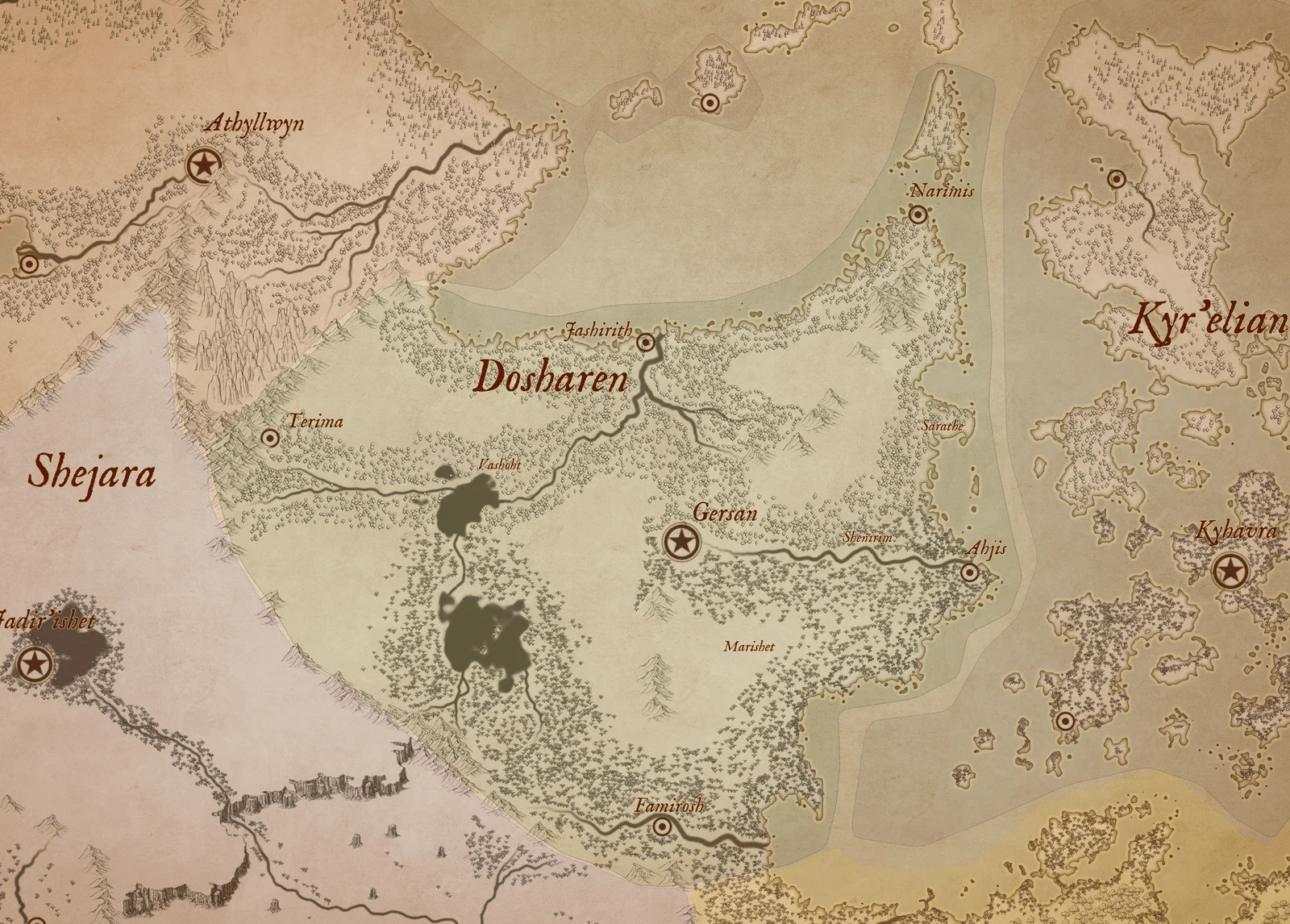
Gersan is a mountain-spring city. Water runs through everything: fast, cold channels in the upper districts near the mountain; used and slower by the time they reach the commercial quarters. The sound of running water is the city’s ambient foundation.
Geography
Section titled “Geography”Gersan sits at the base of a mountain on the city’s western side, sloping downward eastward along a system of spring-fed streams that converge into a river flowing toward the Kyr’elian coast. The mountain provides stone, kerim deposits, and timber. The springs provide fresh water, and the converging streams have been formalized over centuries into canals, millraces, and waterways.
Water quality tells you where you are in the city’s social geography. In the upper districts, the streams are cold, clean, and fast. By the lower commercial districts, they have been used: millwheels, dye works, tanneries, laundry.
Trade position: Gersan is the central hub for inland transportation to the coast. Raw materials arrive, get processed, and ship downriver on flat-bottomed barges. The city’s power comes from position: the funnel through which inland resources reach the coast and coastal goods reach the interior.
Three Poles of Power
Section titled “Three Poles of Power”Gersan grew around three competing centers of power rather than from a single seat of authority.
The House Quarter sits in the upper western districts, closest to the mountain. Noble estates cluster here, each a walled compound arranged around a central council hall. The council hall is not a palace: it is a contentious parliament building that no single house has managed to dominate. The architecture is the finest in the city: Roman-influenced arched construction in kerim-reinforced stone, interior courtyards, mosaic work depicting lineage and notable deeds. Kerim construction gives these buildings an eerily pristine quality, as though frozen in time compared to the lived-in timber-and-plaster districts downhill.
The Yrialin Hall district is the spiritual center of the city, though it does not look the part. The Yrialin’s largest gathering hall is one of the least visually impressive major buildings in Gersan: functional stone, partly timber, built to hold a congregation and nothing more. No kerim reinforcement, no Ren-infused glass, no mosaics. The plainness is deliberate. Set against the kerim-and-mosaic splendor of the House Quarter and the ornamented Order temples, the Yrialin’s refusal to compete architecturally is itself a statement. The district’s signature is auditory: you hear them before you see the building. Voices reading scripture, singing, the hum of a packed room in discussion.
The Gate of Zerathrain campus sits backed against the mountain’s lower slopes, separated from the city by one of the larger mountain-fed streams. Specific bridges cross to the campus, all of which are watched. The architecture is Roman in bones but utilitarian and fortified, visibly marked by use. Locals know the Gate by its sounds: occasional concussive disturbances with no real-world equivalent. Renak feel a dull pressure change. Rennim sense a ripple in their Ren awareness before the physical sound arrives. One thump in a morning is normal. Three in quick succession means something went wrong.
Architecture
Section titled “Architecture”Gersan’s architecture leans Roman, with gothic and Byzantine influences. The Janim build for posterity and civic ambition.
Public spaces are the pride of the city: colonnaded walkways, open forum plazas, public baths fed by Ren-heated water. The Janim argue as cultural sport, so the city has spaces designed for argument. Forum plazas exist in several districts, some formal with tiered seating near the council hall, some informal market squares where vendors and scholars debate between transactions.
Ordinary construction is timber-framed with plastered walls and fired clay tile roofs. These buildings age visibly, get patched and repaired, and have the texture of daily use. The contrast between kerim-reinforced Highborn structures (pristine, luminous, faintly humming to Rennim senses) and ordinary timber-and-plaster is one of the most immediately legible markers of power in the city.
The Mint
Section titled “The Mint”Currency in Dosharen requires Daruner blood to infuse Ren into coinage. The Gersan Mint is located in the House Quarter and is arguably the most fortified structure there. Multiple Daruner-blooded officials from different houses participate in the minting process, because no house can afford to let another monopolize the money supply.
Every coin in circulation was made with noble blood. This is not abstract: it is a physical reality of daily commerce that every resident of Gersan lives with.
The Barge District
Section titled “The Barge District”The lower eastern edge of Gersan is organized around loading and moving things. Where the upper districts are built for impression and argument, the barge district is built for throughput.
The canal system that runs through Gersan was formalized over centuries from the original spring-fed streams. By the time the water reaches the barge district it has dropped significantly in elevation from the upper city, slowed, and widened into channels deep enough for flat-bottomed freight barges. The main loading waterway runs parallel to the city’s eastern edge, with tributary channels branching into the warehouse blocks. Piers are numbered sequentially along the main waterway. Active commercial piers run into the low twenties; higher numbers mark smaller or less-frequented landings further from the main channel.
The canal geography makes the district difficult to move through quickly for the unfamiliar. Canal crossings range from solid stone bridges on the main thoroughfares to plank bridges on barrels in the deeper warehouse blocks. The elevation drop from the middle city to the docks is significant - what looks like a short distance from above requires navigating stairs, ramps, and switchbacks cut into the stone embankment. The terrain rewards people who know it: short sight lines among the warehouse blocks, long ones along the waterway, and enough vertical change that a running person and their pursuer can lose each other in less than a block.
Warehouses in the district fall into two categories. Official holdings - those in house or merchant ledgers, identified by house markings and dock office records - cluster near the lower-numbered piers. Unofficial holdings are harder to read: buildings leased through intermediaries, held under merchant rather than house names, used for goods that do not need the exposure of official manifest filing. The practice is common enough that dock workers do not remark on it. The distinction is invisible unless you are looking for it specifically.
The district’s population is working-class and mixed. Barge workers, dock hands, freight factors, and manifest clerks make up the daily population alongside mill workers who run the lumber and grain operations on the channel branches. Rennim are present - some working legitimate freight security, some in less defined roles. Foreign merchants from Kyr’elian and Gankora maintain small offices near the busier piers. The district is not hostile to outsiders. It is not informative to them either. Questions are answered vaguely. Business is conducted with people you know.
Food & Drink
Section titled “Food & Drink”The Staples
Section titled “The Staples”Dense, chewy bread is the backbone of every meal across all classes. Grain porridge serves the same role for cheaper or faster eating. Root vegetables, beans, lentils, and forest mushrooms round out the base. River fish is the everyday protein. Cured and smoked meats from forest game are daily fare in moderate quantities. Salted ocean fish from the Kyr’elian coast marks moderate prosperity: a family that can regularly afford it is doing well, but not rich.
The class gradient is not about different ingredients. Everyone eats the same core foods. The difference is preparation time, accompaniments, and Ren infusion. Street food is a bowl of grain porridge with fish and herbs, eaten on a bench. A Highborn dinner is the same grain, slow-cooked and seasoned, served alongside multiple courses. Ren-infused cooking enhances flavor, controls temperature precisely, and preserves freshness in ways ordinary preparation cannot.
Serai and Wine
Section titled “Serai and Wine”Serai is a stimulant drink brewed from a highland plant, bitter, served hot, sometimes sweetened. It is the daytime drink of scholars, merchants, students, and anyone who needs to be sharp. Serai houses open before dawn and serve as gathering spots for intellectual life, deal-making, and political gossip.
Wine is made from orchard fruit, varies by valley and vintage, and is the drink of the evening meal. It signals warmth, trust, and social intent.
The two drinks map to a cultural tension within Janim society. Serai represents the intellectual ideal: sharp, productive, disciplined. Wine represents the communal ideal: warmth, the pleasure of a good argument with people you trust. A Janim who only drinks serai is seen as cold and obsessive. A Janim who drinks too much wine is seen as undisciplined. The balance between them says something about a character.
Meal Rhythm
Section titled “Meal Rhythm”Morning is light and private. Bread, cheese, serai. Eaten at home or grabbed from a street vendor. This is the one time of day when Janim are not expected to be social. A quiet morning is respected.
Midday is variable by occupation, eaten on the move or in quick sit-downs.
Evening is the important meal: longer, communal, and argumentative by design. Eating alone in the evening is considered mildly sad. Eating in silence is worse.
Social Customs
Section titled “Social Customs”The Transition Hour
Section titled “The Transition Hour”The hour before the evening meal has specific cultural weight. Serai houses shift atmosphere: the daytime sharp-focus crowd gives way to people settling in, conversation shifts from transactional to social. Some houses serve light wine alongside serai during this window. Invitations to evening meals are confirmed or extended here. The real social positioning of the day happens during this hour.
The Evening Meal as Performance
Section titled “The Evening Meal as Performance”Janim evening meals, especially in educated or Highborn circles, follow an understood pattern. The host proposes a topic, sometimes serious, sometimes deliberately frivolous. Guests are expected to take positions and defend them. The quality of argument matters more than the conclusion. Changing your position mid-meal because someone made a better case is respected, not weakness. The social failures are: refusing to engage, staying silent, or getting genuinely angry rather than passionately loud.
Unwritten Rules
Section titled “Unwritten Rules”Drink signals: Offering someone serai means “let’s talk business or ideas.” Offering wine means “let’s be human together.” Offering both at the same time signals either a very long negotiation or a genuine friendship where the lines blur.
Serai house etiquette: House politics are not discussed openly in a serai house. Serai houses are for ideas, gossip, deals, and academic arguments. If someone starts openly attacking a Highborn house, the owner shuts it down, not out of loyalty but because it is bad for business.
House Quarter access: Walking through someone else’s house quarter without stated business is noticed. Not illegal, but noticed. The kerim-paved streets in those districts are not public the way the forums are.
The Gate of Zerathrain: Technically open to visitors during certain hours, but locals avoid it without reason. The attitude is respectful wariness. Proud the Gate is in your city. Do not want to be nearby when something goes wrong.
Religion in Daily Life
Section titled “Religion in Daily Life”Two faiths share Gersan: the Yrialin, monotheistic, focused on Ylelaim the creator and the testimony of Ylual; and the Order of the Divines, polytheistic, organized around the seven Divines whose existence nobody disputes. Most ordinary people participate in both without resolving the tension between them.
The Cathedral of the Slums
Section titled “The Cathedral of the Slums”Gersan holds the only Yrialin cathedral on the Remnant Continent, and it does not look the part. Locals call it the Cathedral of the Slums. It sits in one of the lower residential districts, built from plain stone and timber, no kerim reinforcement, no Ren-infused glass, no mosaic work. The interior is large enough to hold a significant congregation and furnished for use, not for impression: rows of simple seating, good acoustics, natural light through narrow windows.
Set against the kerim-and-mosaic splendor of the House Quarter or the ornamented Order temples, the Yrialin’s refusal to build grandly is itself a statement. They are asking people to believe in something they cannot see, and they will not dress it up to make that easier.
The cathedral’s signature is auditory. On worship days, the congregation’s singing carries through the surrounding neighborhood and downhill into the commercial districts. Locals register it the way they register the Gate’s thumps: a familiar marker of the city’s rhythm.
Sensory Palette
Section titled “Sensory Palette”Foundation: Running water, everywhere, always. Fast and sharp in the upper districts, deeper and steadier downhill, a low hum at the docks. Characters who have lived in Gersan stop noticing it. New arrivals notice immediately.
Voices: Gersan is loud with argument, negotiation, greeting, and lecture. The forums carry overlapping debates echoing off stone colonnades. Serai houses are a contained buzz. The Yrialin district is a different kind of sound: not silence, but the contained murmur of reading, singing, and earnest conversation spilling from the gathering hall and neighborhood chapels. On worship days, group singing drifts downhill through the city, recognizable and unremarkable to locals.
The Gate: Occasional concussive disturbances. One thump in a morning is normal. Three in quick succession means something went wrong.
Upper districts: Clean stone, mountain air carrying pine and cold earth. Kerim has a faint mineral quality, more like denser air near kerim walls than a proper smell. Rennim sense it clearly; Renak cannot quite identify it.
Middle residential band: Woodsmoke, cooking. The evening meal hour is when the middle city smells best: bread baking, roasted meat, sharp green mountain herbs being added to pots. Serai houses push their particular aroma into the street, something between roasted grain and bitter bark.
Lower commercial and dock district: River mud, wet wood, tannery and dye-work tang, fish, sawdust from lumber mills. Dense and layered. You know you are in the working city by nose before your eyes adjust.
The sun tracks east to west across a city that slopes eastward from a western mountain. Morning light hits the lower districts first. The upper districts wake in mountain shadow. By late afternoon the pattern reverses: golden light on the upper districts, early dusk on the docks. A GM can set the time of day by describing which part of the city is lit and which is in shadow.