Kyhavra
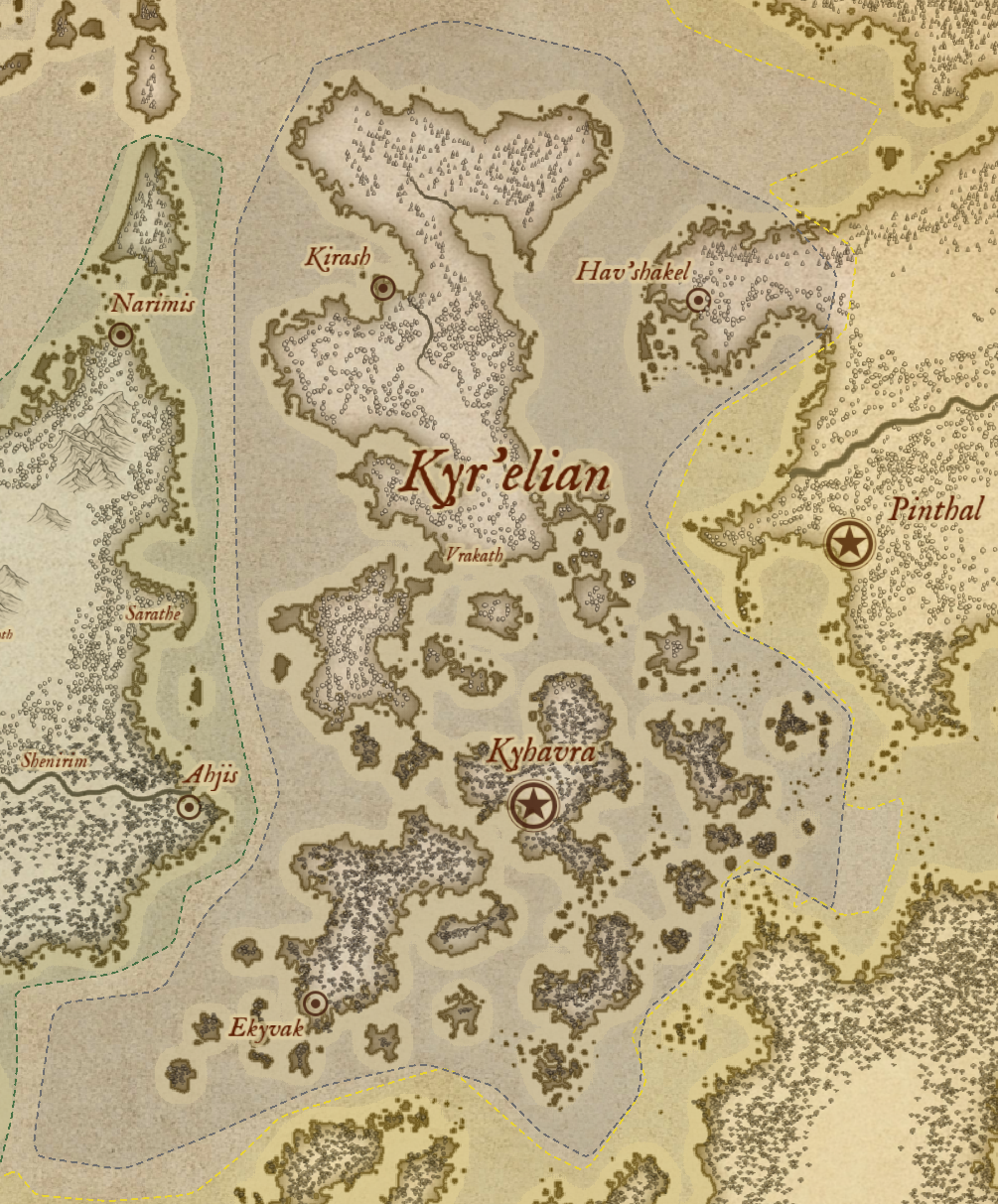
Kyhavra is a city that grew out of a harbor rather than around a square. It climbs from a deep natural anchorage up the surrounding hillsides, its oldest waterfront districts compressed beneath centuries of construction stacked above them. The Assembly meets here, the embassies are here, and the most significant concentration of Elathi seers on the continent works here, quietly. But the thing to understand about Kyhavra, and about Kyr’elian generally, is that the city does not end at the waterline. The channels are part of the city. People live, work, and travel on the water as readily as on the streets, and the rhythm of the tide is as present in daily life as the rhythm of the day.
This page anchors in Kyhavra, but Kyr’elian life is archipelago life. Much of what is true in the capital is true across the channels that connect it to Ekyvak, Prakath, Kirash, Hav’shakel, and Vrakath.
The Channel Is the Road
Section titled “The Channel Is the Road”A Kyr’elian child learns to handle a small boat about the time a Gersan child learns to cross a busy street. Boat-literacy is assumed. Distances are measured in tides and sailing time rather than in miles, and a person’s mental map of the archipelago is a map of lanes, currents, and crossings, not of roads.
This shapes everything downstream. A neighborhood is defined by which landing serves it. A person’s day is organized around when the water is favorable, not just when the sun is up. Goods, news, and people all move by hull, which means the waterfront is where the city’s information lives. If you want to know something in Kyhavra, you go down to the docks, not up to the Assembly.
The open channels between major islands are highways, with all that implies: regular traffic, known hazards, places where the current does something you respect, and a shared etiquette of right-of-way that everyone learns young and nobody writes down. The Keldar keep the larger lanes clear of the threats that would otherwise make this life impossible, which is why a Vrakath patrol is a more present fact of daily reassurance here than any law the Assembly passes.
How Standing Works
Section titled “How Standing Works”Kyr’elian has no titles worth the name. The Elkyr egalitarianism that founded the nation runs all the way down into how people address one another and how they decide whom to trust. You are what your record says you are. A reliable hand, a sharp trader, a captain whose crew comes back: these reputations are built on the water and travel by word of mouth faster than any document.
The practical effect is a culture of use-names and earned standing. Where a Nyl announces position and a Dosharen Highborn announces house, a Kyr’elian announces what they can do, and is quietly judged on whether the next day proves it. Bluster is cheap and the sea is not. A person who oversells themselves on the dock finds out fast, because the work tests the claim.
This is not a soft or sentimental equality. It is closer to the Anamor standard of judging outsiders on what they can do and what they can withstand. Kyr’elian is welcoming to newcomers precisely because it does not care where they came from, and it is unforgiving in the same breath, because it cares a great deal whether they can pull their weight.
The Lineage Mix
Section titled “The Lineage Mix”Kyr’elian is the most lineage-diverse nation on the Remnant Continent, and not by accident. Generations of open-door trade brought Elkyr, Janim, Nyl, Anamor, and others into the same ports, and the merit culture gave them a common ground that their home cultures did not.
Elkyr are the founding and numerically dominant people, and the maritime culture is theirs at its root: superstitious, individualist, egalitarian, built for motion.
Janim brought scholarship, institutions, and trade-record discipline. A great deal of Kyr’elian commerce runs on Janim bookkeeping, and the technically minded work, navigation instruments, shipwright innovation, the handling of Ren exerters, draws heavily on Janim practice.
Nyl are the most interesting case. Everywhere else on the continent, Nyl identity is hierarchy: position is everything, the collective supersedes the individual, reputation is fought over like territory. Kyr’elian offers a Nyl none of that scaffolding. A Nyl who settles here gives up the structure that defines Nyl life elsewhere and is judged, like everyone else, on what they can do. Some find this unbearable and leave. Some find it a relief they could not have named at home. The Nyl who stay tend to be the ones who wanted out of the hierarchy in the first place.
This puts Janim and Nyl on the same deck as equals, which happens almost nowhere else. The thousands of years of enslavement and the distrust it bred do not vanish at the waterline. But Kyr’elian is the one place the two peoples routinely work side by side without the imperial structure of Lithywae or the long grievance dictating the terms. The result is not reconciliation. It is something more like a working truce that the work itself enforces.
Anamor, particularly the Leviathan clan, are a constant presence in the waters around Kyhavra, operating in the channels toward Corvesh and Pinthal as readily as in their home waters. Their aquatic traits make them formidable in and under the water, and the deep relationship between Kyr’elian and the United Anamor Nation means a Leviathan-clan Anamor on a Kyhavra waterfront is an ordinary sight rather than a remarkable one.
Work and Money
Section titled “Work and Money”Kyr’elian runs on trade and the moving of things, and almost every livelihood touches the water somewhere. Sailors, dockhands, factors, shipwrights, chandlers, pilots, and the clerks who track all of it make up the working population. Ship-ownership is the closest thing to a ladder of ambition: a hand becomes a mate, a mate buys a share in a hull, a share becomes a vessel, a vessel becomes a concern.
Kyr’elian mints no currency of its own. It has no Daruner Mint and no interest in one, and so it runs on foreign coin and on credit. Dosharen coinage is common, arriving through Ekyvak with the western trade, and Gankoran goods move through Kyhavra in the other direction. For sums that matter, much of the real economy runs on standing rather than metal: credit extended between traders who know each other, settled later, backed by reputation. This is the practical face of the merit culture. A trader’s word is an instrument, and a trader who breaks it does not get a second one.
The Assembly’s standing levy that funds the Keldar is the one tax everyone feels, and opinions about it map cleanly onto the civic-merchant-naval friction. Merchants grumble and pay because clear lanes are worth it. Naval communities consider it the floor, not the ceiling. The remote islands resent paying for patrols they rarely see and grumble loudest of all, right up until the season a monster tide reminds them why the levy exists.
Where People Live
Section titled “Where People Live”Kyhavra’s housing reads its history vertically. The oldest construction sits right on the water, narrow and dense, much of it now built over and built upon as the city stacked itself up the hillsides. Wealth, such as it is in a place that distrusts hereditary display, tends to climb: the higher districts catch the air and the view, the lower ones catch the trade and the noise.
A significant part of the population lives afloat. Liveaboard vessels and houseboats cluster in the sheltered parts of the anchorage, some permanent homes, some belonging to people who are only ashore between voyages. A liveaboard community is its own neighborhood, with its own etiquette about wake, noise, and whose lines cross whose. To an outsider it looks like clutter. To a Kyr’elian it is addresses.
Across the archipelago the pattern repeats at different scales: a major port like Ekyvak or Prakath builds up and out from its landings, while a small island might be a single village wrapped around one sheltered cove, its entire identity organized around the safe water it sits on.
Food and Drink
Section titled “Food and Drink”Kyr’elian eats from the sea and from the world. The base of the diet is what the water provides: fish fresh and preserved, shellfish, seaweed, and the salt that preserves all of it for the next voyage. Salted and dried fish is not a poverty food here the way it reads elsewhere. It is provisioning, the thing you live on at sea, and it is prepared with the care a seafaring people gives to the food that keeps them alive far from port.
What lifts Kyr’elian cooking above its neighbors is that a trade hub eats what trade brings. Spices, grains, fruit, and preparations from every nation the ships touch arrive in Kyhavra and end up in the pot. A waterfront cookshop might serve a Dosharen-style grain dish one day and a Gankoran preparation the next, depending on what came in. The cosmopolitan table is itself a kind of status: a household that sets a varied spread is signaling reach, the way a Janim household signals it with a well-argued evening meal.
Drink runs to what keeps and what travels. Strong preserved spirits and fortified drink hold up on a voyage where fresh water spoils, and a captain’s stock of good drink is a working asset, used to seal a deal, welcome a crew aboard, and mark a safe return. The safe-return drink in particular carries weight, because the thing it celebrates is never guaranteed.
Superstition and the Elathi in Daily Life
Section titled “Superstition and the Elathi in Daily Life”The Elkyr are superstitious because the sea is genuinely unpredictable, and Kyr’elian daily life is full of the small observances a seafaring people accrete: things you do and do not do before a voyage, words you do not say aboard, the way a vessel is named and the care taken not to tempt the water. None of this is doctrine. It is the folk practice of people whose lives depend on conditions they cannot control, and even those who claim not to believe it tend to keep the observances anyway, because the cost of keeping them is nothing and the sea is the sea.
The Elathi sit at the serious end of this same impulse. Where ordinary superstition is a sailor knocking a particular rhythm on a particular rail, a seer is someone who has developed a genuine attunement to the Sea and Protection polarities and can perceive a threat in the water before it surfaces. Seers are few, and most voyages sail without one. When a seer is aboard, the crew does not treat the arrangement as optional. They hold no authority and ask for none. They are valued the way a skilled physician is valued: not for status, but because they catch what is wrong before it kills you. Kirash, in the forested north, is where the tradition runs deepest and least casual; in Kyhavra it is quieter and more woven into ordinary maritime life.
Social Customs
Section titled “Social Customs”The dock is the forum. News, gossip, deals, and reputation all move through the waterfront. A person who wants to be part of the life of the city is seen at the landings. Conducting your affairs entirely indoors and out of sight reads as either grand or suspect, and Kyr’elians are not fond of grand.
Right-of-way is character. The unwritten etiquette of who yields to whom on a crowded channel is learned young and watched closely. A person who handles their boat with consideration and skill earns a quiet kind of respect, and a person who throws a careless wake through a liveaboard anchorage earns the opposite. How you move on the water is taken as a fair sample of how you move through everything.
Take the stranger’s measure, not their origin. A newcomer is welcome to try, and nobody will hold their lineage or their past against them on arrival. What they will hold against them is failing to pull their weight after being given the chance. The welcome is real and the patience is short, and both come from the same place.
The safe return is sacred. A crew that comes back marks it, and a crew that loses someone marks that too. In a culture with few formal institutions and no hereditary structure, the rituals around departure and return carry the social weight that ceremony carries elsewhere.
Sensory Palette
Section titled “Sensory Palette”Foundation: Water against hulls and pilings, always, the way running water is the foundation of Gersan. Rigging works in the wind, lines creak, blocks knock. Gulls and the other shore birds. The bell or call that marks a tide or a watch. A Kyr’elian stops hearing all of it and a new arrival hears nothing else.
Voices: The waterfront is loud with trade in a dozen accents, the polyglot noise of a port that takes all comers. Hailing between vessels and dock carries across water with peculiar clarity. The Assembly districts are quieter, the Elathi quieter still.
The wrong sound: Sailors register the sounds that mean trouble, a change in the water’s note, a wind shifting where it should not, before they consciously name them. The whole culture has an ear cocked for the sea doing something unexpected.
The waterfront: Salt first and last. Tar, hemp, and wet rope. Fish at every stage from fresh to long-cured. The particular reek of a working dock, low tide on mudflats, and the cleaner salt air out past the anchorage.
The cookshops: The cosmopolitan table announces itself by nose. Spices and preparations from every nation the ships touch, layered together along the food streets in a way that exists nowhere else on the continent, because nowhere else does the whole world’s cargo come ashore in one place.
The hill districts: Cleaner air the higher you climb, the working reek of the harbor thinning into salt wind and woodsmoke.
Light and Motion
Section titled “Light and Motion”Light here is never still. It comes off the water, doubled and moving, and it catches the metallic silver of Elkyr skin in a way that makes a crowd on a bright Kyhavra dock shimmer. The city’s mood tracks the water as much as the sun: a flat calm anchorage and a chop-driven grey day are different cities. A GM can set the tone of a Kyr’elian scene by describing the state of the water before anything else, because that is what a Kyr’elian reads first.