The Keldar
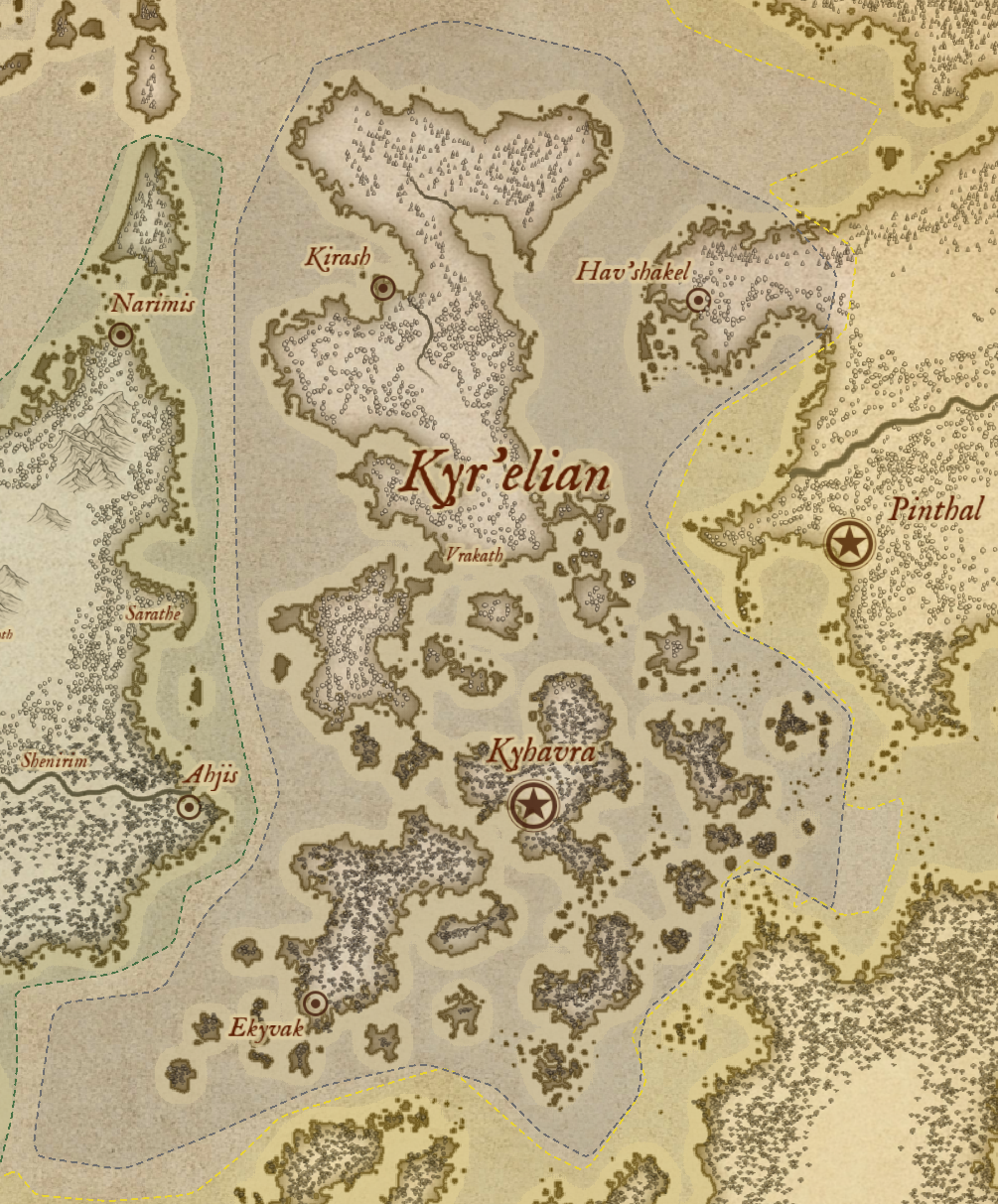
A Company-sized maritime force operating out of Kyr’elian, the Keldar patrol the archipelago’s waters and outlying islands. They handle what the Assembly’s standard forces are not built for: monster tides rolling in from open water, piracy between the islands, and the kind of threat that requires immediate, overwhelming response rather than a measured one.
Their formal name is Kyr’eldran, “Company of Kyr.” Most people call them the Keldar. Their own members say Kyr’el.
Most people outside Kyr’elian call them the Mad Dog Crew. Not to their faces: that’s an easy way to get beaten.
Overview
Section titled “Overview”| Type | Assembly-sanctioned maritime combat force |
| Founded | Longstanding institution, date uncertain |
| Headquarters | Vrakath, Kyr’elian |
| Jurisdiction | The Kyr’elian archipelago and surrounding waters |
| Size | ~100 active members (Company-strength) |
The Keldar are not the force you call when you need something handled carefully. They are the force you call when you need something stopped.
They answer to the Assembly, but the relationship has always been one of considerable operational autonomy. The Keldar go where the threat is, move fast, and resolve the problem with whatever force is necessary. Kyr’elian’s Assembly funds them, commissions them, and largely stays out of their way. The arrangement suits both parties.
They are not the first choice. They are the right choice, when a situation has moved beyond ordinary response.
Operations
Section titled “Operations”The Keldar divide their work into two categories, though in practice the two overlap constantly.
Monster tides are the older threat: surges of Ren creatures from the deeper water that descend on coastal villages and smaller islands without warning. The archipelago’s geography makes early warning difficult and rapid redeployment harder. The Keldar’s role is to intercept tides before they reach population centers, operating from patrol vessels that keep moving between islands rather than garrisoning fixed positions.
Piracy is a newer and more complicated mandate. The archipelago’s trade routes make it a target, and the same island geography that protects small villages also gives cover to those who prey on shipping. The Keldar pursue, board, and when necessary destroy vessels operating outside the Assembly’s law. They do not do this quietly.
Both operations require rapid insertion, immediate escalation, and a unit comfortable operating far from resupply. The Keldar are built for exactly this.
Ren Exerters
Section titled “Ren Exerters”The Keldar’s most defining feature, and the source of their reputation.
For most of their history, the unit maintained dedicated Rennim within their ranks specifically for fire support: Elkyr exerting through the Law of Flux, channeling force and motion into concentrated strikes at range. It was effective. It was also limited by how many Rennim could be recruited, trained, and sustained at Company strength.
When Ren exerters emerged from the Gate of Zerathrain, the Keldar recognized what they were looking at before most military institutions had heard of the technology. They were among the first to acquire a significant stock, among the first to run live trials in actual combat conditions, and among the first to build doctrine around the devices.
The results were predictable. The exerters allowed the Keldar to bring artillery-level Ren output to any engagement regardless of how many Rennim were present that day. The unpredictable part was how enthusiastically the unit took to this.
The Keldar do not use exerters conservatively. Budget reviews consistently show the majority of their operational expenditure going to exerter procurement and the Ren cores required to power them. After-action reports from their engagements involve, with unusual frequency, the phrase “structural total loss.”
Whether this is effective doctrine or institutional temperament is a debate other people have. The Keldar’s results speak for themselves, and the results tend to involve a great deal of smoke.
Structure
Section titled “Structure”The Keldar operate at Company strength, approximately one hundred members, and maintain that size deliberately. Large enough to split into independent patrol elements, small enough to know every face in the unit.
There is no elaborate rank structure. An officer cadre handles coordination and speaks to the Assembly. Below that, the unit operates on the flat trust typical of Elkyr culture: you earn your standing by what you do, not what you were called when you arrived.
Ren exerter operators are not a separate specialty so much as an expectation. Members who cannot effectively operate exerters in field conditions are rare. Those who are particularly skilled with them are noted and positioned accordingly in engagements, but there is no formal designation.
Members tend to stay. The Keldar are not a stepping stone to something else. For most who join, it is the thing.
Reputation
Section titled “Reputation”The Mad Dog Crew nickname originated outside Kyr’elian and has since spread across the continent among people who have heard of them secondhand. The reasoning is transparent: they arrive fast, they escalate immediately, and they leave a great deal of destruction behind.
From the inside, the Keldar find this reputation variously amusing and irritating depending on the member. What they object to is the implication of recklessness. The destruction is intentional. The speed is intentional. If a monster tide has reached the outer islands, the window to stop it before it hits the villages is narrow. The appropriate response to a narrow window is not a measured one.
The name is not used to their faces. This is wise.
Relations with Other Factions
Section titled “Relations with Other Factions”To be expanded.
Known Members
Section titled “Known Members”To be expanded.